Abstracts and AnswersBy Ruth Travis As a staffing and research volunteer in the Chaska History Center building on Fourth Street, I frequently hear one of my favorite questions: “Can you tell me about my Chaska house?” And yes! Far more often than not, yes, we can. Although the answer is not always immediate or as complete as we might hope, and the search is often a journey rather than a race, the adventure is a reward in itself. A Search BeginsA young couple, who had purchased a home in Chaska in 2024, attended the Ess property archaeological presentation in September. Afterward, they approached me to ask about their home’s history. Learning their address and knowing that their home was in the original Chaska boundaries as defined in 1851, I began explaining the process to obtain the abstract of title associated with their property. An abstract is a paper document that, paragraph by paragraph, describes the history of all transactions relating to the ownership of a particular property. Most often these days, when a home sale is closed by a title company, the closing agent retains the abstract and files it at the appropriate county location; the homeowners don’t have immediate access to it. Surprisingly, however, after I described to the homeowners what an abstract looks like, they realized the home’s previous owners had left theirs in a kitchen drawer, buried under owner’s manuals for their household appliances. Half an hour later, they returned to the History Center, abstract in hand. |
|
|
|
|
|
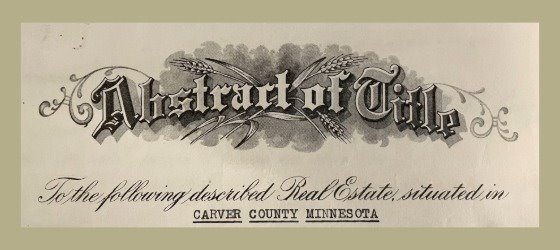
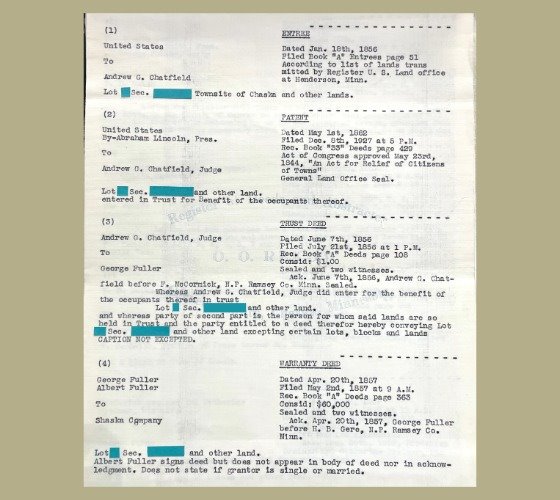 A title page and first page of an abstract for property in Chaska, dated January 1856. The second notation demonstrates the act of Congress and the deed of lands under President Abraham Lincoln. Then it goes onto George Fuller and the transfer of the property to the Shaska company. (Photos: Chaska Historical Society) |
|
|
|
As is true of many of the oldest properties in Chaska, their abstract was opened when Chaska was one of an estimated 700 “paper towns” in Minnesota Territory—land granted to early entrepreneurial land speculators when this area was deemed safe for settlement. In the Historical Marker Database, a historical marker in Mendota, Minnesota, reported that towns were speculated into existence by prophets and profiteers. . . . Complete with dozens of residential blocks, elaborate parks and beckoning schools, these imaginary towns only existed on paper until investors could be found to turn them into realities. Many never even came to fruition. Chaska, however, did come to fruition, as we know. The area attracted not only farmers and the logging industry but also immigrants who were willing to take a chance on building a residence and starting a business in town. Twists and TurnsThis couple’s abstract spans the period from the first official entry in 1856 until the last update in 1982. It reveals an intriguing series of land deeds and actions executed by acts of Congress, legal actions, sales, and transfers of ownership. That the abstract concludes in 1982 most likely indicates that this one was considered lost and another was later reconstructed from county records. As of November 2025, the homeowners were requesting the abstract on file from Carver County. Because this was the couple’s first home and they knew little about the early history of Chaska, I began deeper research: - Explained about Chaska land speculators
- Clarified the twists and transfers of their block and lot ownership that had occurred through the years predating a sale to the Shaska Company—a land speculation company that mapped out the original Chaska downtown area
- Described when and how their lot was later sold to private ownership
- Discerned when a 2-room house was actually built and occupied on their lot
- Defined how their property was later sold, deeded, and willed forward over the ensuing 169 years
I then went back to the beginning and researched each family that had owned the house to build summary profiles of who they were and what their lives in the home were like. (An unexpected surprise was the discovery that a young man who had lived in the home with his parents married Beatrice Ess in 1924, the daughter of John Ess and granddaughter of Joseph and Hubertina Ess—a link to the Chaska Historical Society event that had first drawn this inquiring couple to our door!) We also looked at the Sanborn Fire Insurance maps to better understand the home’s development. (Surveyors created the Sanborn maps to document every structure in town—size, building materials, etc., for insurance purposes. The maps were updated periodically, providing snapshots of a property over time.) The maps showed how the house grew from the original structure to later added square footage, and had then further evolved with the installation of electricity and indoor plumbing. As these new Chaska residents begin to tackle necessary repairs and bring new life to this property, they will have more questions. We welcome those, as well as the opportunity to support the couple’s venture into this community. They are so vested in and eager to learn everything they can about the history of their “new” old home, as well as our community. It is truly a joy to walk this journey with them. |
|
|
|
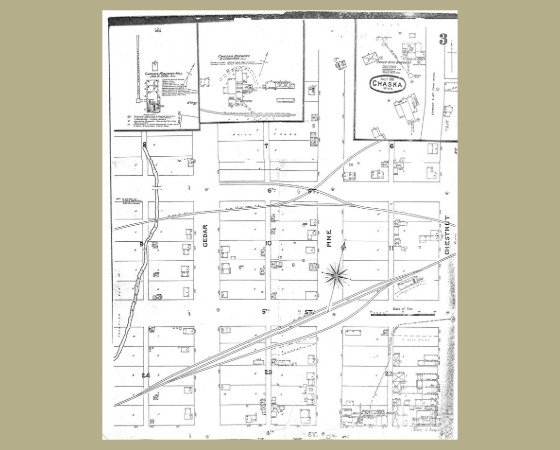 A Sanborn insurance map from 1891 shows a portion of downtown Chaska west of Chestnut St. (Photo: Chaska Historical Society) |
|
|
|
An Abstract DreamWouldn’t it be wonderful if we could eventually create a database depicting the history of ownership of every home in Chaska? What a wonderful reference tool that would be! The Chaska Historical Society has made a start already. As is our practice when anyone with an abstract chooses to share it with us, Chaska board member Doris Coghill makes and files a copy for CHS records, as well as creating a digital copy for the homeowner. The original abstract and the digital copy go back to the homeowner. They can keep the digital file and return the original to Carver County. We welcome all who are willing to share their abstract with us. In addition to homes in the city limits of Chaska, our archives also offer historical Carver County plat maps that allow us to piece together the history of farmland and more recent housing developments. If you wish to learn more about the previous owners of your property, we can guide you in that process. How can we help you? We welcome your questions! |
|
|
|
Discover Your RootsBy Carrie Drephal, Chaska Historical Society Genealogist |
|
|
|
|
|
Genealogy continues to be one of the most rewarding ways to connect with history—both personally and locally. At the Chaska Historical Society (CHS), we’re proud to help community members uncover their family stories, and we’re excited to announce that our Genealogy Series presentations will return January 10, 2026 for its second year, meeting one Saturday a month through July. Registration for the series will open before the end of 2025, so stay tuned for details. During the past year, participants celebrated some remarkable wins: breaking down brick walls that had stumped their research for years, compiling family histories into narratives to share with loved ones, and uncovering a trove of religious records that revealed information on many members of one researcher’s family. These successes show just how powerful genealogy can be in unlocking stories that were once thought lost. The Genealogy Series has quickly become one of our most popular programs. Each session focuses on a different theme—such as vital records, immigration, or newspapers—giving participants practical tools they can use right away in their own research. The series also includes research group days once a month, during which attendees can work directly with the CHS genealogist to ask questions and get hands-on help with their family history challenges. Over time, the program has grown into a supportive community of researchers who learn, share, and celebrate discoveries together. In addition to our public series, CHS also offers private presentations tailored to community groups. Recently, we shared a special program at Chaska’s Adelwood retirement community, at which residents enjoyed learning practical research strategies and asking a variety of questions about their own family histories. Programs like this are a wonderful way to spark conversations, bring generations together, and connect people with their heritage. If your organization or group would like to schedule a private genealogy program, let us know—we’d be happy to bring this unique experience to you. CHS also provides a variety of resources to support your research journey. Our archives hold photographs, maps, local genealogies, and historic records that can offer clues about your ancestors’ lives. We also maintain a subscription to Ancestry.com, available for on-site use at the Chaska History Center building, which opens up access to millions of digitized records from around the world. Pairing these tools with our local expertise helps researchers make connections they might not find anywhere else. Whether you’re a beginner just starting to piece together your family tree or a seasoned researcher tackling tough genealogy puzzles, we’re here to help. Genealogy is not just about names and dates—it’s about understanding the lives, struggles, and triumphs of those who came before us. Their stories add depth to our community’s history and create a bridge between past and present. Mark your calendars for January 10, 2026, and join us for another exciting year of genealogy programming. Together, let’s discover the stories waiting to be told. For more information or to ask about private presentations for your group, contact the Chaska Historical Society at historical@chaskahistory.org or call us at 952-448-6077. |
|
|
|
Chaska's Past, Right in Your Hands
|
|
|
|
|
|
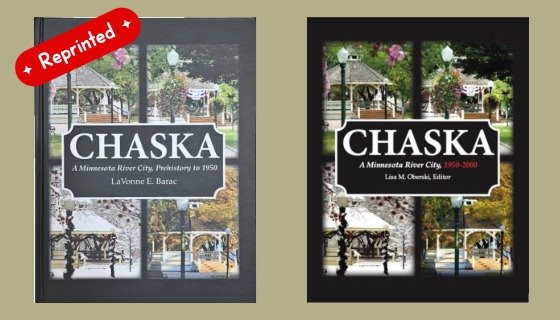
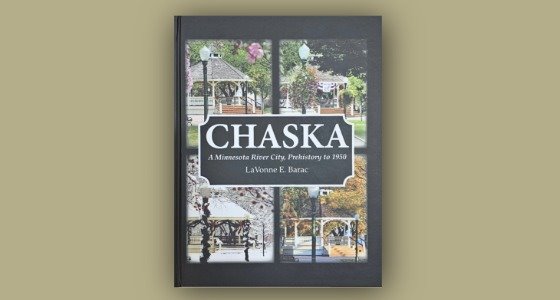
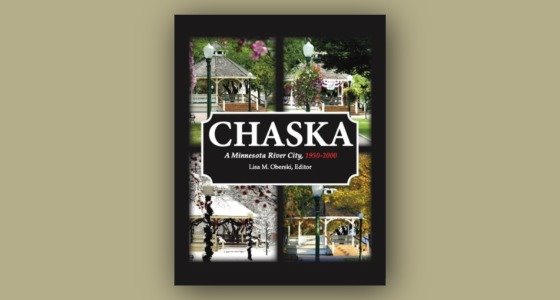
Don’t just remember history, own it! A beautifully matched set of comprehensive history books tells a story of the people, places, and proud heritage of Chaska, Minnesota. Packed with photos, clippings, and remarkable detail—built to last. A treasure for every home, library, or history lover! Available as a matched set or individually. Back by popular demand, Volume 1, Chaska: A Minnesota River City, Prehistory to 1950, has been reprinted and is available once again for purchase! $75 per volume. Pick up a copy at the Chaska History Center building: 112 West Fourth Street, Chaska, MN 55318. Or order yours online: historical@chaskahistory.org. |
|
|
|
Chapters in Time: So Much History in One CornerBy Charles Pederson City Square Park in downtown Chaska has long been the heart of the city. To the north, across East Fourth Street, was property belonging to the Chaska Moravian Church. This included the church building on the corner of Walnut and Fourth and the parsonage to its west (in the middle of the block). The other corner, at Fourth and Chestnut, was an anchor of Chaska education and civic life for many decades. |
|
|
|
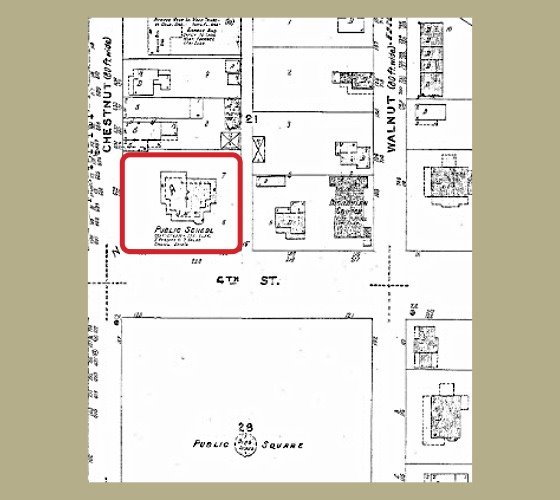 The Moravian Academy and Park School/city hall were at the corner of Fourth and Chestnut streets (outlined in red). “Public Square” designates City Square Park. A 1924 Sanborn Insurance map shows the footprint of the building that later became the city hall. (Photo: Chaska Historical Society) |
|
|
|
Chapter 1: Moravian AcademyNearly 600 years ago, in 1457, like-minded believers founded the Moravian Church in Bohemia, a region of modern Czechia (Czech Republic). Its official name was Unitas Fratrum (“unity of the brotherhood”). The church officially recognizes “the danger of self-righteousness and judging others without love.” That motto, though, did not prevent the members from being judged, persecuted, and scattered. Many fled to Germany to live under the protection of a sympathetic nobleman, Count Zinzendorf. |
|
|
|
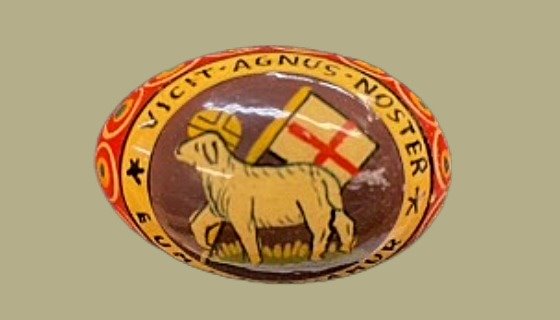 A lacquered Easter egg from the Chaska Moravian church bears the seal and Latin motto of the Moravians, “Our Lamb has conquered. Let us follow him.” (Photo: Charles Pederson) |
|
|
|
From Germany, the Moravians began a gradual outreach to many global areas. Over the centuries, these included East Africa, the Caribbean, and (via Bethlehem, Pennsylvania) Chaska, Minnesota. Pennsylvania remains the headquarters of northern Moravians in North America. Unclear is why some Moravians ended up in Chaska. Possibly they came for the usual reasons: to buy cheap farmland or band with others of a similar religious or ethnic background. A New SchoolWhatever the reason for immigrating, Chaska Moravians conducted their first worship services around 1858. The first church building was built in 1859. Though Moravian children attended the local public school, the parents found it insufficient (it was open for only three months a year). The idea of a more rigorous Moravian-supported school was floated. The idea received enthusiastic support from the Moravian church leadership in Pennsylvania. An 1867 letter to the Carver County newspaper, the Valley Herald, explained that a two-story brick building was planned as “a first class institution and also a well paying concern” where the students would receive an excellent education. The school would even “afford an opportunity for such as wish to enter college to prepare themselves thoroughly for the purpose.” |
|
|
|
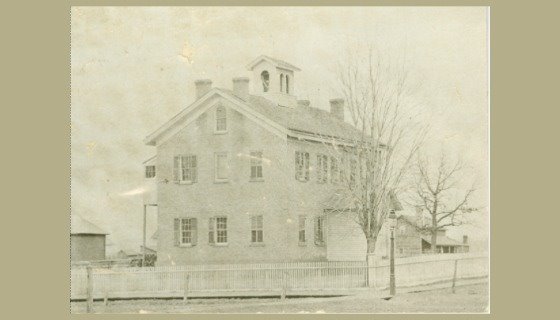 The two-story Moravian Academy served all students, regardless of church membership. At its height, the boarding school hosted students even from out of state. (Photo: Chaska Historical Society) |
|
|
|
The first classes were held in mid-November 1864. Anyone who could pay the tuition was welcome to attend. These yearly fees ranged from $6 (primary) to $8 (intermediate) to $11 (upper). Attending were 41 boys and 36 girls, “a reasonable number of inmates,” according to the Valley Herald. School subjects included reading, spelling, and writing in English and German and other more specialized subjects. The music course had to be postponed briefly because “the piano was ice-bound at LaCrosse, Wisconsin,” reported a retrospective Herald article. The two-story building was suitable both for instruction and for boarding students from elsewhere. Students came from Belle Plaine and Fort Snelling. Later students came from as far away as Wisconsin and Illinois. Ebb and Flow of the Academy’s FortuneThe positive news masked gathering shadows. In 1867 the Valley Herald reported that the school was successful in some ways. However, it did not earn enough to “pay the interest on the large investment to establish it.” Matters worsened when an offshoot Moravian church was established in Laketown Township, near Waconia. Some of the tuition-paying members from that area left the academy, preferring a shorter trip to school and church. By spring 1870, just three years later, the institution was forced to close its doors because of lack of funds. Further falling enrollment made hiring qualified teachers difficult. “At times the academy was operating with only one teacher and the local pastor on the staff,” according to LaVonne Barac in Chaska: A Minnesota River City, Prehistory to 1950. The building was eventually shuttered as a Moravian school. The local school district came to the rescue. Apart from the academy, a public school had been operating since 1859 on the southeast corner of Maple and Second Street. Despite previous upgrades, by 1877 “Chaskans agreed something had to be done about the old school. Its condition was poor and it was overcrowded,” wrote Barac. Money had been set aside for further upgrades. Rather than move ahead with that, however, the school board decided on a different direction. The money was used to buy the Moravian Academy building in September 1877 for $1,500. It was renamed the Park School because it was across from the only park in town at the time, City Square Park. Chapter 2: The Era of Park School/City HallThe old academy building served its purpose as a school for several years. Eventually, however, it reached the end of its useful life as a school. The mid-1870s saw a community debate about the future of the corner lot. Many thought the location was too close to local businesses, the lot was too small, and the building unsuited to children. The Valley Herald proclaimed it to be “in a dangerous condition, and quite likely to tumble down as soon as the frost commences to get out of the ground.” Finally, the old building was demolished. In 1890, a new “castle-like” school building was erected. Local Chaska bricks provided its creamy color. |
|
|
|
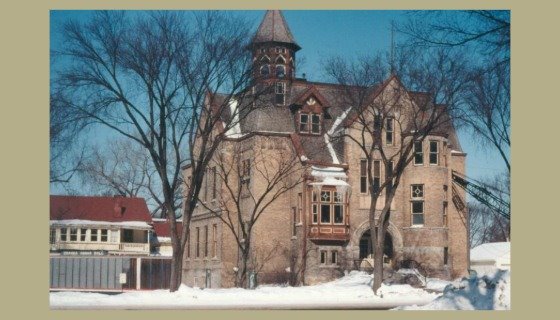 The stately brick Park School later served as the city hall and fire department. (Photo: Chaska Historical Society) |
|
|
|
The new Park School building educated Chaska pupils for many decades. But as always, times change, things wear out, and upgrades are needed. So also with the school. “By the 1930s, it too [the Park School building] had become both inappropriate and dangerous as a school,” according to Barac. “The city purchased the building for $3,000.” Many Chaskans had happy memories of Park School. Doubtless, they would have liked to see it continue. Yet, not everyone saw value in investing money into the building as a school. In April 1930, the Automobile Club of Chaska proposed closing the school and hiring an architect to explore refitting it as a civic building. In 1931 the city condemned the building for use as a school, and a new school was built down the street. Still, the structure was not finished with Chaska. In 1936 Chaska city acquired the Park School from the district. The regal building was renovated for civic use. Renovations included pouring a concrete basement and renovating a garage for a fire engine and other firefighting equipment. Space for a city clerk’s office and a library were carved out. On the third floor, city council chambers were arranged. A unique feature of the council chambers, according to a Herald article, was a fireplace, “conceivably the only [one] in any city hall assembly in the state.” The Park School building was now fit for duty as the city hall. At the time, the council was made up of nine aldermen (all just happened to be men). The aldermen led various areas of city administration, such as handling licenses, caring for parks and cemeteries, keeping roads and sidewalks in good repair, and enforcing city ordinances. Today, of course, the council consists of four ward representatives and a mayor. No barriers exist to the seats being open to either sex. The end of the Park School/City Hall era came decades later, with the building’s sale and demolition in 1967. The Chaska Herald reported, “The ol’ city hall structure will be torn down . . . writing the final chapter.” City offices were moved down the street to the C. P. Klein house, at the corner of Walnut and Fourth Streets, across from City Square Park. Chapter 3: BanksThe now-empty corner lot was purchased by Carver County State Bank (CCSB). The institution was the county’s oldest bank, established in 1870. It had been started, wrote Barac, as a “private banking business in the rear of [George DuToit’s] pharmacy in Carver.” In 1874, the bank had been moved to Second Street East in Chaska. It now looked to move to the old city hall lot. Rather than a stately Chaska-brick building, a red-brick, one-story, flat-topped building, typical of commercial architectural styles of the late 1960s, was erected on the old city hall site. An ad in the Chaska Herald extolled its up-to-the-minute features, including an automatic check-sorting machine. |
|
|
|
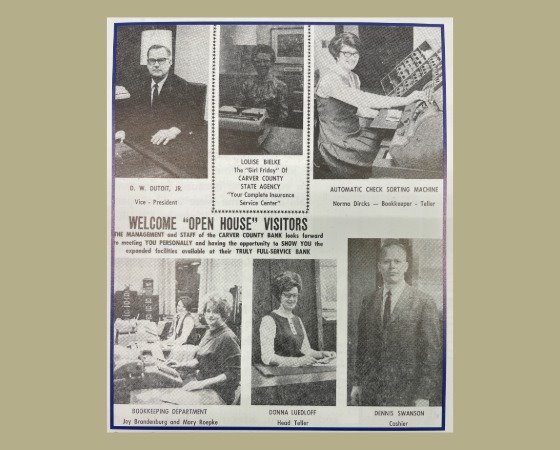 Newly opened at the corner of Fourth and Chestnut, Carver County State Bank emphasized customer service. (Photo: Chaska Historical Society) |
|
|
|
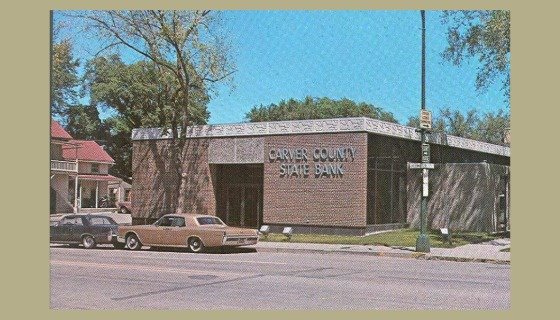 Carver County State Bank purchased the site of the Moravian Academy, constructing a low-profile red-brick building. (Photo: Chaska Historical Society) |
|
|
|
CCSB merged with Citizens State Bank of Green Isle in December 1989. By that time, the DuToit family had sold its shares in the bank. The sale, according to the Carver County Herald, was meant to “give the bank greater service capabilities.” It became known as MidAmerica Bank–Chaska, with a slightly expanded footprint. |
|
|
|
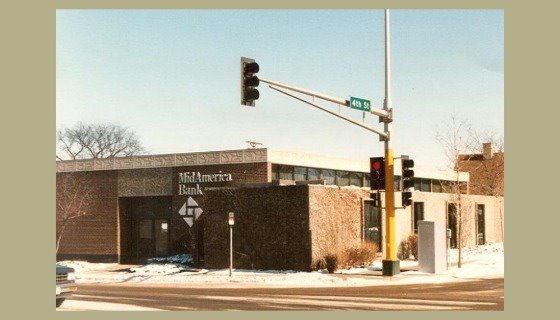 In 1989 Carver County State Bank was sold to Mid-America Bank. (Photo: Chaska Historical Society) |
|
|
|
In mid-2000, the bank transitioned to Wells Fargo. To keep up with the times, the exterior was changed to a terrazzo-style pebbled look, but the profile remained largely the same. |
|
|
|
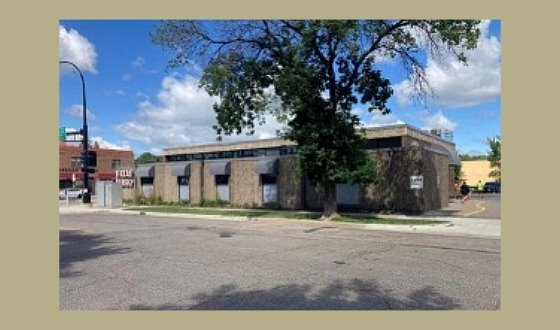 Around the year 2000, the building changed hands again, becoming a Wells Fargo branch. Although the exterior finish changed, the building remained essentially unchanged. (Photo: Charles Pederson) |
|
|
|
Epilogue: More to Come?The Wells Fargo bank building has stood at the corner of Fourth and Chestnut for many years. It has become a familiar downtown landmark. As history has shown, however, change continues. Isn’t it exciting to think about what the future could bring? Learn More!Books and Internet- Barac, LaVonne E. (2019). Chaska: A Minnesota River City (Vol. 1, Prehistory to 1950). Chaska Historical Society.
- Lehman, Anton C. (n.d.). Moravian Academy of Chaska [1864]. In Estella L. Elke (ed.), The Moravians of Carver County, Minnesota, 1858-1933.
- Moravian Church. (n.d.) A Brief History of the Moravian Church.
- Oberski, Lisa M. (ed.). (2024). Chaska: A Minnesota River City (Vol. 2, 1950–2000).
- Wollin, John O. (n.d.). The Moravian Church of Chaska. In The Moravian Church, Chaska, Minnesota, 1858-1948.
Newspapers (Available at Chaska Historical Society or Carver County Historical Society) - Barac, LaVonne. (1989, January 5). Carver County State Bank Merges, Changes Its Name. Carver County Herald.
- Valley Herald. (1864, June 11). An Academy to Be Built in Chaska: An Unlimited Appropriation Made by the Moravian Church at Bethlehem, Pennsylvania [Letter to the Editor].
- Valley Herald. (1867, March 23). The Moravian Academy.
- Valley Herald. (1867, March 30). Moravian Academy.
- Weekly Valley Herald. (1867, May 4). [Moravian Academy].
- Weekly Valley Herald. (1867, May 11). “School Affairs.”
|
|
|
|
Volunteer Spotlight:Syd Ridek-BernnBy Amanda Ridek-Bernn |
|
|
|
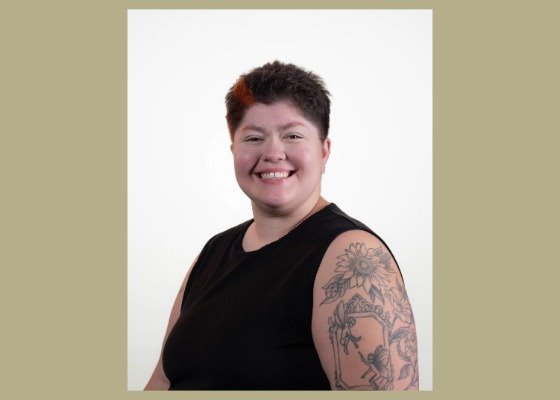 Syd Ridek-Bernn (Photo: Syd Ridek-Bernn) |
|
|
|
If you had the opportunity to attend one of the Hauntings & History tours in October 2025, you’re likely to have met Syd Ridek-Bernn, one of Chaska Historical Society’s newest volunteers. Syd’s interest in the Hauntings tours was immediate, and they completed training for becoming a guide with CHS in late September. Syd was raised in Chaska, and they hold many fond memories of exploring the local downtown area. “I have spent all my conscious years living in Chaska,” they note, “. . . walking to the clayhole before the Firemen’s Park makeover and swimming, jumping off the large raft over and over again.” They have a special warmth for the local city festivals—Taste of Chaska, River City Days, and Fire & Ice have been family favorites throughout their life. A common experience during the summers was hiking the Chaska trails with their babysitter, following the edge of the Minnesota River and getting ice cream before seeing a movie at the then “new” Rex Theater (which is now Meadow Spring Church). They frequent Linda’s Cellar, a Chaska antiques shop, every time it opens and often visit Hayloft Studios—a former livery stable. “I have so many favorite spots here,” says Syd. “La Hermosa, Cooper’s, Rising Dragon, the library . . .” Syd holds a degree in English education (language arts) from Minnesota State University, Mankato, and is pursuing secondary licensure for special education. They are a teacher at Performing Institute of Minnesota (PiM) Arts High School in Eden Prairie and are enjoying their second year in the English department with their bright, skilled students. Teaching came naturally for Syd; they worked as a babysitter as some of their earliest employment experiences and always knew they wanted to pursue a profession in high school education. They engaged with multiple opportunities locally, specifically with the Chaska Community Center’s Extreme Kids summer program, and they worked as an English tutor for Sylvan Learning in the Chaska Commons. They greet every day motivated to provide an encouraging, optimistic presence for the students in their classroom—and now they’re passionate to bring that same energy to preserving and sharing local history. They were directly invited and encouraged to participate in projects by Lisa Oberski, president of the Chaska Historical Society, after Syd’s spouse had begun volunteering just a few months prior. Syd met the invitation with a thrilled “Absolutely” and joined the team in June, participating in various areas of the historical society. They have expressed a deep excitement for participating in the Hauntings & History tours and joining the writer’s team for the CHS newsletter. “Being an English teacher, I have a love for writing,” they explain, “for telling stories, for communicating with people.” With their background in education and leadership, joining the tours circuit came naturally. One of their favorite experiences with the historical society thus far was this year’s retreat at Charlson Meadows west of Chanhassen. They loved being able to gather with everyone who has a passion for history, community, and our city. Learning what was going on at the history center building was energizing for them, and they sincerely appreciated the opportunity to hear new ideas and contribute their own. Syd mentioned that they’ve learned many valuable lessons from being involved with the historical society. In just a few short months, they’ve put into practice key strategies for teamwork and collaboration. “I have worked on projects with people who work drastically different than I do,” they say and noted the value of being able to step forward with curiosity. Getting to know other people’s processes when developing and executing projects has been foundational in helping them grow. In the time they aren’t teaching and volunteering, Syd loves to write, read, and craft. They regularly make small clay sculptures and weave bracelets to sell at art markets, the proceeds of which are donated to charity. They’ve self-published two poetry books, and they are now working on a fiction manuscript. |
|
|
|
Free Horse & Carriage Rides at Downtown's Hometown Holiday!
|
|
|
|
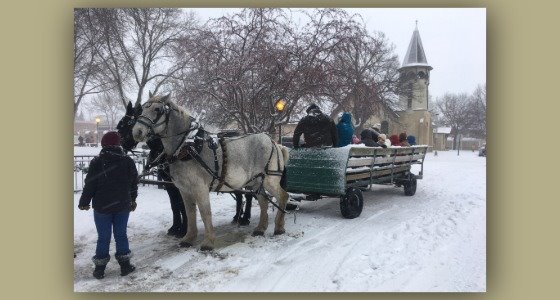 People enjoying a horse and carriage ride at Hometown Holiday. (Photo: Chaska Historical Society) |
|
|
|
The jingle-jangle of sleigh bells is coming! You’ll see us again sharing Chaska’s rich history on the horse-and-carriage rides on Saturday, December 6! Meet us in City Square Park between 2:00 and 5:00 p.m. for your FREE old-time ride and other holiday activities. Follow it up with a visit to the Chaska History Center building (112 Fourth Street West) to see this season’s exhibit, do some shopping, and play with vintage and antique toys! We’ll hope for snow and reasonable temperatures!!! |
|
|
|
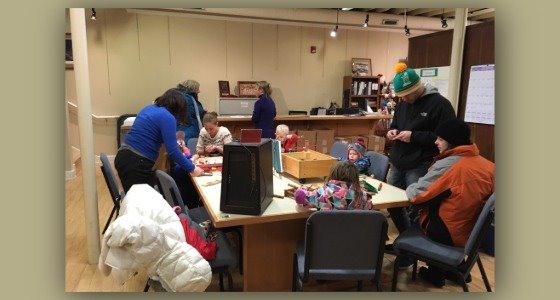 People playing with vintage toys inside the History Center. (Photo: Chaska Historical Society) |
|
|
|
A Chaska Christmas StoryBy Marilyn Savelkoul Gahm While indexing Volume 2 of the book Chaska: A Minnesota River City, 1950-2000, I saw the photograph of the 1958 Christmas Midnight Mass procession in Guardian Angels Catholic Church on page 363. |
|
|
|
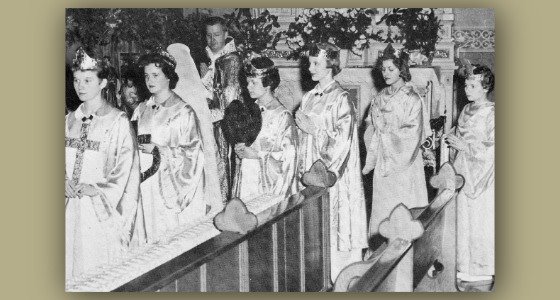 Senior girl parishioners participating in the 1958–1959 Christmas procession preceding Midnight Mass at Guardian Angels. Left to right: Jeanette Pierson, Carol Ess, Shirley Williams, Sandra Mieseler, Darlene Geyen, Polly Lubansky. Father Clement (background). (Photo: Angel Review, 1959). |
|
|
|
A girl at Guardian Angels School, or GA, had two opportunities to be in the annual Christmas Eve procession, once in second grade and again in senior year—and I was lucky to be chosen both years. My family has a generations-long relationship with GA. On Christmas Eve 1956, I was a very excited second grader. Back then, there was no “early” Midnight Mass, which today often starts at 10:30 p.m. Then, Midnight Mass began at midnight. My parents were worried I would fall asleep, but no chance of that! The Nativity scene, with large statues, was set up at the right-side altar—but the manger was empty. The church was always packed as worshippers came to view the procession of second graders and senior girls, who brought the Baby Jesus statue from the main altar down the main aisle, across the back of the right-side pews, and up the side aisle, where the priest placed Baby Jesus in the empty manager, signifying the start of Christmas Day and of Midnight Mass. Six second graders were needed to portray little angels. The first angel led the procession, ringing a bell. The second carried a lantern, lighting the way. Then came three senior girls portraying the “virtues”—Faith (carrying a cross), Hope (an anchor), and Charity/Love (a heart). Some of these props can be seen in the photograph, with the anchor looking suspiciously like a cardboard cutout covered in aluminum foil. Additional older girls may have been portraying adult angels (fuzzy memory). And finally came Mary, carrying her baby on a satin pillow. A ribbon fell from each corner of the pillow, each ribbon held by one of the remaining four second-grade angels. I was the lantern angel. There would be, however, no lighting the way to the stable, as the electronic gadget that furnished the light failed just before the procession started. I was a very shy kid, and the nuns intimidated me, so I think my shyness was sometimes misinterpreted during my first few years in school. When I worked up courage—at the last minute—to tell the nun supervising the procession that my lantern was dark, she just sighed and said, “Of course, this would happen to you.” Fast-forward 10 years to Christmas 1966. The Guardian Angels High senior girls who were GA parishioners, including me, were called into a school hallway to pull pieces of paper out of a box in a random drawing—some slips blank, some with the name of a Christmas Eve procession figure. I picked out the slip reading “Mary.” The costumes were the same as the ones from a decade earlier, and maybe decades before that, so they were a bit “tired.” My mom, Clara, was a talented seamstress/tailor so she got to work on alterations. We swapped parts of the gown, cloak, and veil, transforming some pieces into other parts. The gown/cloak had several layers—and the veil arrangement was heavy and long and hard to secure to my short hair. As Mary, I was to carry the fragile Baby Jesus on his pillow. This time, the supervising nun’s pre-procession comment was more like, “Drop the statue and you’re dead.” After Mass, onlookers provided positive comments about my portrayal of Mary. The modest, downward gaze, the bent, unmoving head, the look of adoring devotion at the divine miracle I was carrying to the Nativity scene. Ha! That was fear, folks—fear! I’m staring at the irreplaceable Baby Jesus figure unsecured on a slippery satin pillow, my hands unavailable for remedial action if needed because they’re tucked under the pillow, whose four ribbons are being tugged in four different directions by four little kids, all the while hoping—and praying, considering the location!—that the precariously balanced and cobbled-together veil and cloak would not slither off my head onto the aisle. The procession seemed to last an eternity, each step a misery, until an unbroken Baby Jesus was delivered to his manger. After the service, I noticed several of my male classmates casting odd looks at me. Nothing like portraying the Blessed Virgin Mary to disconcert the boys in your class! (Marilyn indexed Volumes 1 and 2 of the Chaska history books, published by the Chaska Historical Society, as well as the original two-volume set that later were combined to become Volume 1. She has indexed other books for the Chaska and Carver County historical societies.) |
|
|
|
Chaska Historical Society: Year in Review 2025By Lisa Oberski, CHS President |
|
|
|
|
|
The first quarter of the new century ended for the Chaska Historical Society (CHS) with another busy year of activities permeating the community. One of our proudest successes was receiving the George C. Klein “Service Above Self” award from the Chaska Rotary Club in March. This award, which dates back to 1980, goes to a Chaska person or organization that has made a notable difference in building our community through their service. Our volunteers have much to be proud of! Because our all-volunteer staff continues to be the foundation of activities throughout the year, we work to support and applaud each other’s accomplishments. In March, we celebrated our common mission and focus at the former Cuzzy’s restaurant in Chaska. We reconnected as a volunteer group again in July, where, during a meeting at Charlson Meadows, west of the Arboretum on Highway 7, we considered our past, present, and future as an organization. And it’s a bright future! 2025 was filled with activities! We brought several exhibits to life: - “Women of Chaska: Grit and Grace.” Honoring the women of Chaska through the years. The work the volunteer team contributed for this major exhibit has paid off: Since its late June unveiling, we’ve had more than 200 visitors—and anticipate many more!
- “The Minnesota River: Landmark and Liability.” Remembering the experience of the 1965 flood. This exhibit first appeared at the Carver County Fair, where more than 2,000 individuals had contact with it; it was later moved to the Chaska Library, where an additional 8,000-plus were exposed to it!
- “The Tyrannical Twister.” It’s been 100 years since the 1925 tornado that wreaked havoc in downtown Chaska! First appearing at our booth during popular downtown events, this exhibit followed the flood exhibit at the Chaska Library for further exposure.
We offered bimonthly genealogy research and workshop sessions from January through July. Professional genealogists offered help and advice on many topics, highlighting useful resources: birth, death, and marriage records; census records and newspapers; immigration and court records; and real estate and military records. We spearheaded other well-received events: - “What?! Murder and Mayhem in Chaska?!” tours, which occurred in April and May. Seventy-eight people joined us for these tales of the “seamy side” of Chaska history.
- The “Graveside Tales” tour, this time held in Guardian Angels Cemetery, was offered in June. Reenactors in full period dress retold stories of Chaska and important early residents. Both sessions were fully booked—with 48 persons joining us on the walk through the cemetery—and through history!
- The “Hauntings & History” tours continued, as well. Stories about historic homes and buildings—and possibly of spirits who have never left. We enjoyed the company of nearly 200 individuals!
Our partnerships with other local groups expanded our reach: - We worked with the Chaska Library again this year, connecting children to Chaska history by having them recreate historic Chaska buildings using LEGOs. This popular program for kids was followed by the travelling exhibits for all ages already mentioned. We look forward to additional opportunities for sharing events and exhibits with this community asset!
- We teamed up with the Carver County Historical Society for the Carver County Fair history exhibit and staffing on 1965’s disasters. We also joined them at Fall on the Farm at the Historic Andrew Peterson farm. We offered our vintage and antique toys for kids to try out. In addition, we partnered with the county and hosted their archeologic talk on the Ess property in downtown Chaska.
- The generous support of the Lions Club’s monetary donations and the American Legion’s allowing us to use their space for larger events has enabled us to connect with more people than ever before. We are most thankful!
- We’ve become a regular contributor to Carver County Local News (cclocalnews.org), sharing our activities and historic quips from the Herald!
- Partnerships with the Downtown Business Alliance and the SouthWest Metro Chamber of Commerce allow us to connect with local business communities in new ways!
- Historical presentations at Adelwood retirement homes and the Lodge at the Chaska Community Center have been well received, with more than 80 audience members.
We were visible and accessible, too, at many community events: - Taste of Chaska, May
- Fire & Ice, July
- River City Days, July
- Touch-a-Truck, August
- Pop-up Saturday events, late August to mid-September
- Latin Music and Food Fest, September
- Downtown Trick or Treat, October
- Hometown Holiday, December; you’ll see us again on the carriage rides for this local favorite!
In addition to all of these, we have been helping many individuals and organizations with their research requests, maintaining an active social media presence, staffing the Chaska History Center building on Tuesdays, Fridays, and Saturdays, and adding to and maintaining our collections—whew! We’re a busy crew. We look forward to 2026, optimistic that we will continue to reach our local community, expand our footprint, and meet our mission to connect people to Chaska history in a way that is accessible and relevant! |
|
|
|
Fall at the FarmBy Ruth Travis I had the pleasure of accompanying our Chaska Historical Society (CHS) president, Lisa Oberski, on September 20 to staff the CHS tables for Carver County Historical Society’s Fall on the Farm event. This was my first visit to the Andrew Peterson Historic Farmstead and far more than I expected. The house is captivating, the barns are handsome, and the lawns are expansive. As we set up for the day, the sense of a perfect Minnesota autumn morning was enhanced by the smell of a log fire as the Carver County Historical Society staff prepared to begin toasting sandwiches. |
|
|
|
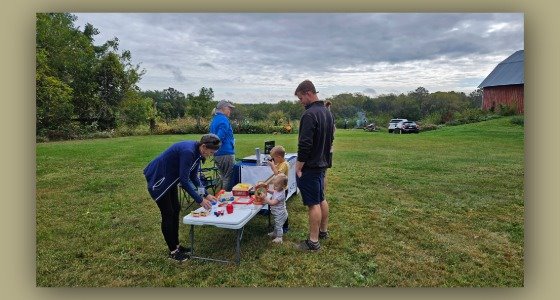 Lisa and Ruth staffed the CHS table. They offered information and a chance to use old-timey toys. (Photo: Jayna Hulleman, Carver County Historical Society) |
|
|
|
The event itself opened at 10:00 a.m. with blue skies and a steady flow of youngsters, leading their parents through the many opportunities to explore all that were offered. Among the activities, children were invited into the vegetable garden to dig potatoes and carrots for the food shelf information table on site. They were rewarded for their efforts with a freshly cut garden flower and cherry tomatoes plucked from the vines. In conjunction with a peek at the thriving pumpkin and garden squash, youngsters were welcomed to choose and carve a pumpkin of their own to take home. Children and adults alike enjoyed the farm-animal petting zoo, including llamas strolling on leashes, cuddly bunnies, potbelly pigs, frolicking goats, and the dramatic honking of large geese parading among the colorful chickens. Games and toys were of course a draw as families strolled the farmstead, from potato sack racing against newly met friends, searching for quarters in the depths of a straw pile, making their own toys from scrap fabric and colorful yarns, and our CHS hands-on exhibit of vintage toys. |
|
|
|
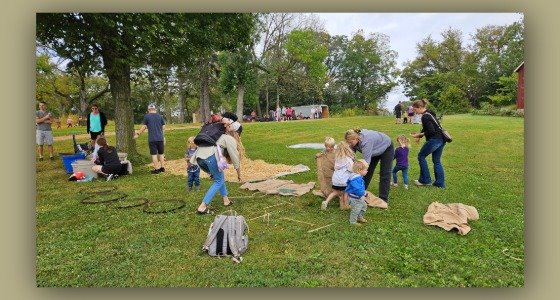 Treasure seekers tried to find a quarter in the pile of straw. (Photo: Jayna Hulleman, Carver County Historical Society) |
|
|
|
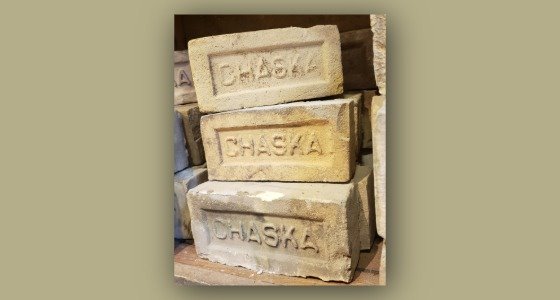
Parents and grandparents shared their memories of childhood favorites and were also very interested in upcoming CHS events, the Chaska history books we offer for upcoming holiday gift-giving season, and the examples of Chaska brick on our tables. For many, only after visiting us did they recognize the use of Chaska brick in the construction of the Peterson house and the remarkably well-preserved Chaska brick outhouse. And of course, Fall on the Farm would not be complete without a tractor ride—on this day, a lawn tractor pulling a train of brightly painted oil drums perfectly cut to accommodate young passengers and the adults who couldn’t pass up the opportunity to ride along. |
|
|
|
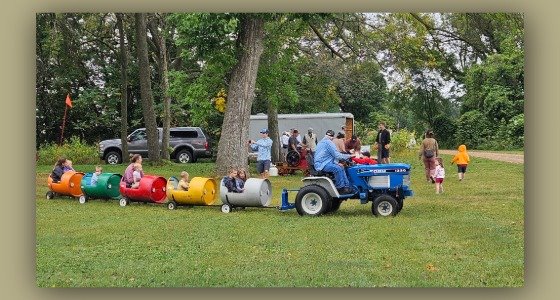 Children got a train’s-eye view of the goings-on. (Photo: Jayna Hulleman, Carver County Historical Society) |
|
|
|
If you haven’t had an opportunity to volunteer with CHS for a community event, I encourage you to do so. The Chaska Historical Society has so much to offer, and these public outreach events are always rewarding, for both our volunteers and the guests who stop to chat. Whether visitors to our tent or table have lived in Minnesota their entire lives or are new to our community, everyone has a story—as does Chaska. In this busy world, I believe people are hungry for a sense of community, and Chaska is a pretty great place to be! |
|
|
|
For Your Holiday ConsiderationBy Lisa Oberski, CHS President |
|
|
|
|
|
Chaska Historical Society (CHS) volunteers are probably best known as those crazy people who cheerfully talk about Chaska’s history on the carriage rides in subzero weather. Or maybe as the ones who share tantalizing historic tidbits from Chaska’s former local newspaper, the Herald, which dates back to 1862. Maybe you know us from this year’s Hauntings & History tours or the yearly exhibits we curate for the greater Chaska community. Did your school class or Scouting group visit the Chaska History Center building for a presentation? Were you a member of the Lodge—Chaska Community Center’s hub for active older adults—who toured the community with a CHS docent? Regardless, we provide many services to the Chaska community—all as volunteers. That’s right. We are all volunteers—from president of the board to all who staff the desk and run the museum, including archiving pictures and artifacts and genealogical resources for the public to see at no cost. Why? We do it because we care. We care about the Chaska community. We care about its rich history dating back 1,500 years to the time of the indigenous people who are buried in the mounds in City Square Park. We care about the Dakota people who more recently lived in the area. We care about the early settlers arriving in the early 1850s, about the brickyards and brick industry that began in 1857, about the evolving agricultural community and the transitions over time to Jonathan New Town, biotechnology, and more. We tell Chaska’s stories. We tell how the community developed and how change was the only constant. We talk about the civic organizations and churches and community events that have brought and continue to bring people together. And we share stories of floods and fires and other disasters that have also brought people together, even those who otherwise might not associate because of different beliefs or ethnic backgrounds or bank account balances. We preserve the historic web of support that makes Chaska unique from other, more typical suburban communities. And we do it in the way our community has always done it: helping one person at a time. Finding that image of a birth mother for the child who never knew her. Giving Grandpa bragging rights by finding that 1940s story in the Herald that tells about his athletic prowess on the baseball diamond. Interviewing the people who lived Chaska’s many changes and chose to provide support in the ways they knew how. We keep making connections. We keep recording the stories that build this community of ours from the ground up. Yes, our community has gone from a 100-year stagnant population of 2,000 in 1950 to 28,000 today. But we haven’t lost the desire to support our entire community, one relationship at a time. Yes, the connections are looser than 100 years ago, necessitated by the greater population. But they’re still here. And we want that to last, which is why we’re still here. We understand that not everyone is interested or able to volunteer at the Chaska Historical Society, online or in person. We would, however, appreciate your considering a donation to help us continue our mission of serving the Chaska community as it evolves and grows. You can make a lasting difference. It’s your choice. |
|
|
|
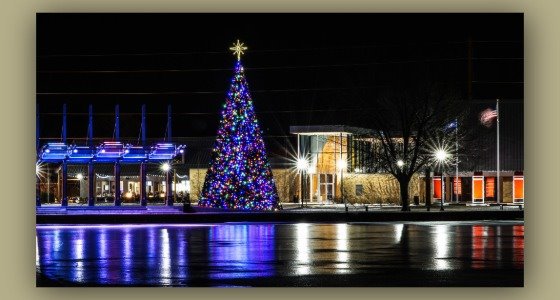 The Christmas Tree at Firemen's Park (Photo: Norbert Lucas). |
|
|
|
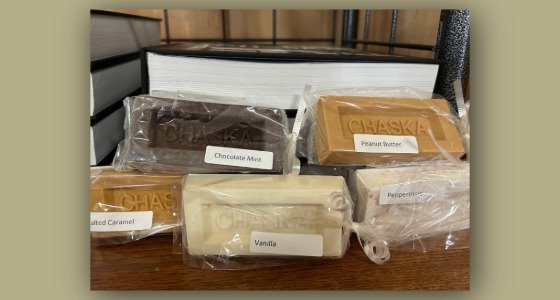
Holiday Gift FavoritesFrom Chaska Historical SocietyWant a meaningful gift, memento, or piece of Chaska to take home? Our curated collection has just the thing. From locally written history books to handcrafted keepsakes and treats, each item celebrates Chaska’s stories and spirit. Come find a special piece of the past! All items are available at the Chaska History Center during open hours, or you can browse the complete collection at the Chaska History Center website. Purchases support the Chaska Historical Society’s mission to preserve and share local history. |
|
|
|
Chaska: A Minnesota River City, Prehistory-1950 (Back in Stock!)
|
|
|
|
|
|
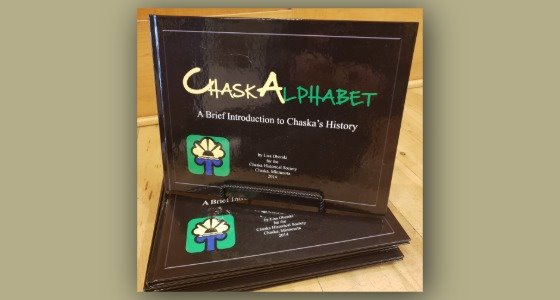
Chaska: A Minnesota River City, 1950-2000
|
|
|
|
|
|
|
|
|
|
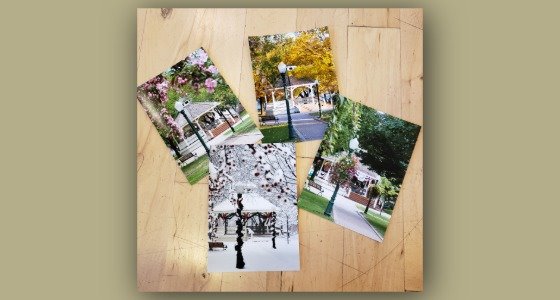
Gazebo - Four Seasons Cards
|
|
|
|
|
|
|
|
|
|
|
|
|
|
|
|
|
|
|
|
|
|
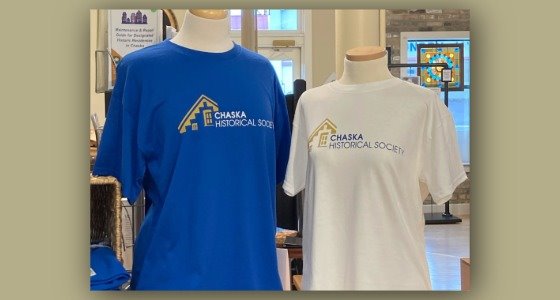
Chaska Historical Society T-Shirts
|
|
|
|
|
|
|
|
 (Photo: Suzy Hazelwood, Pexels) |
|
|
|
We need you to join our team of writers. This is an excellent work-from-home opportunity. From an occasional gig to a longer-term commitment, from a short newsletter item to a longer research article—we have a place for you! Join our fun group of interested volunteers and help us: - Write Facebook posts (1–2 hours per post)
- Create brief newsletter articles on CHS activities (2–3 hours per 3 months)
- Produce researched newsletter articles (5-8 hours per 3 months)
First draft of newsletter articles is due 2 months before newsletter publication. Final articles are due 1 month before. - Scheduling: very flexible, with attention to quarterly deadlines.
- Expectations:
- Writers receive a general idea of topic(s), with lots of independence to pursue any topics of interest.
- Writers determine and inform the newsletter editor of how much guidance they need along the way.
- Writers must be open to revision to maintain integrity of the newsletter and accuracy of the research.
Help our fun-loving team of dedicated volunteers reach out to the Chaska community and beyond and make a difference—now and into the future. |
|
|
|
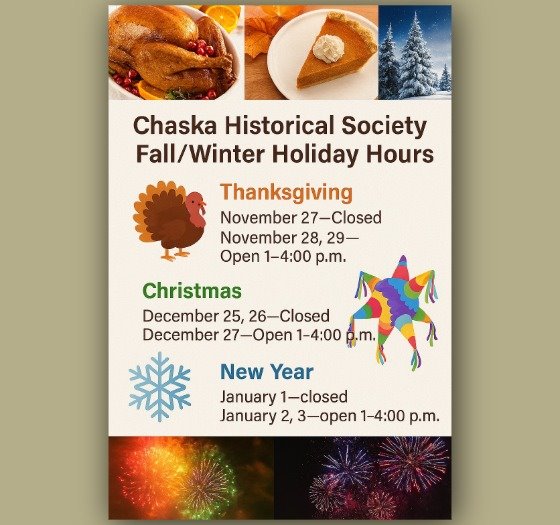
Chaska Historical Society Fall/Winter Holiday Hours
|
|
|
|
|
|
|
|
|
|