Volume 3, Issue 3, August 2022
|
|
|
|
Chaska History Center Artifact DiscoveriesHarnesses, shoes and historian - all in the Glatzel family!
Joseph Glatzel opened a business of hand-making harnesses in 1889 in downtown Chaska. With his nephew Edward, their business was very successful making cart and wagon harnesses, horse collars and boots for the settlers in the area. |
|
|
|
 Figure 1. Glatzel Advertisement
|
|
|
 Figure 2. Glatzel Sewing and Cobblery Equipment
|
|
|
 Figure 3. Glatzel Shoe Shop in 1930
|
|
|
|
In 1910, before the auto industry emerged, the Glatzel shop produced 73 sets of single and double harnesses. Recognizing that the demand for harness work would soon change due to the automobile industry, Joseph Glatzel brought his nephew Edward Glatzel into the shop as an apprentice in 1916 to begin his training in leather work. To enhance his ability to provide customers quality shoe repairs and custom leather work, Edward purchased shoe repair equipment. The Chaska History Center’s artifact collection includes a Singer sewing machine and cobblery pieces (Figure 2).
By 1930, Ed Glatzel had established his shoe shop at 113 West Second Street (Figure 3). He was an active community member serving on Chaska’s City Council for 18 years. Additionally, he became Chaska’s amateur historian, and unofficial genealogist and recorder of hundreds of facts about the City’s history. His interest in genealogy began when a letter arrived from Germany in Chaska after WWII. Foreign relatives wanted to know about their cousins in Chaska, so the research and collecting of facts became his hobby.
Edward’s research of families and the general daily life in Chaska covered the span of time from 1864 through 1960 and included details of almost 6,000 past residents of our community. Those records are available at the Chaska History Center.
|
|
|
|
Come see the “2nd Street- Chaska’s First Downtown” exhibit featuring the many businesses of 2nd Street, and the Glatzel records. We hope to see you soon at the Chaska History Center! |
|
|
|
Volunteer Opportunity
The Chaska History Center has an opportunity for data entry volunteers. You would work with our new database, entering information about objects and photos that have been donated. Training will be provided. Contact the History Center if you are interested. Call 952-448-6077 or via email: historical@chaskahistory.org
|
|
|
|
Volunteer Spotlight - Bev Westerling
An integral influence on Bev Westerling’s life came through a high school Civics teacher who encouraged exploring history. Bev grew up in south Minneapolis and graduated from the Roosevelt High School. The high school has a lengthy list of notable alumni that have had successful careers in human services - which she was encouraged to pursue.
As a recent graduate of University of Minnesota, Bev worked in the field of social work and mental health services, primarily with vulnerable adults. Bev married her musically talented husband, a trumpeter and member of the U. S. Army Band. After his Army service, they returned to the Twin Cities and raised two daughters.
Bev worked 25 years for Hennepin Family Services-Dakota County, then retired in 2011 and moved to Savannah, Georgia. There, she lived a half block from the ocean and enjoyed visiting the many historical sites and large plantations in the area. Following the death of her husband, Bev returned to her Minneapolis roots. Bev is an avid reader who enjoys the antics of her feline companion, Scarlett. |
|
|
|
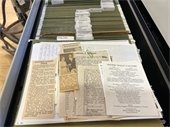 Figure 1. Genealogy and Obituary file work by Bev Westerling
|
Bev works at the History Center (usually on Fridays) and her contributions to the Center has included the Subject Files organization, collaboration on the WWI and WWII display, and the Why Chaska? exhibit. She is currently working with the Genealogy/Obituary files (Figure 1)to create a more complete record that can be digitally available to our members.
|
|
|
|
Chaska: A Minnesota River City Quiz #6 |
|
|
|
Here is Quiz #6-questions about Chaska: A Minnesota River City, Prehistory to 1950. These questions are taken from the material in the chapters covering 1920 through 1949. - In what year did the Chaska City Council appropriate funding for the city’s Library?
- In the 1920s, which Carver County towns had women mayors?
- In 1922, who was the chairperson for the newly-formed League of Women Voters?
- In 1933, what Chaska business was affected by a 5-alarm fire?
- In what year was the first “talking picture” movie shown in Chaska?
- What fate befell Joseph Jasek and Joseph Marczinski?
- In what year was Chaska’s first Girl Scout chapter formed?
- After it opened in 1933, what not-yet famous band leader visited Chaska’s Valley Ballroom?
- In what year were Driver’s Licenses first required for Minnesota automobile drivers?
- In 1939, what became available to Chaska residents?
- In what year did Chaska win its first Minnesota Amateur Baseball Championship?
- In what year was the first television placed in a Chaska bar?
- On January 28, 1956, what major change occurred in Chaska’s communication system.
- In 1942, what was the allotted ration of coffee per person?
- How many men from Chaska died as a result of World War II?
- How many children in John Dahlke’s family served in the military during WWII?
|
|
|
|
Chaska: A Minnesota River City Quiz #5 Answers |
|
|
|
Here is Quiz #5 - questions about Chaska: A Minnesota River City, Prehistory to 1950. These questions are taken from the material in the chapters covering 1900 through 1919. - In January 1900, what referendum passed 194 to 44 that funded a $7,000 bond in Chaska? Answer: Construction of an electric power plant. Page 256.
- What was Chaska’s population in 1900?
Answer: 2,400. Page 260. - What religious denomination provided a “buffer” between Catholics attending Guardian Angels and Lutherans attending St. John’s church?
Answer: The Moravians. Page 267. - What historical landmark is recognizable in the photo of 4th Street on page 267?
Answer: The Chaska History Center. Page 267. - In 1917, what US legislation was authored by Minnesota Representative Andrew Volstead? Answer: The Federal Prohibition Act. Page 335.
- In 1910, what was the monthly salary for a County Commissioner?
Answer: $14.58. Page 374. - When did the County Courthouse install indoor plumbing and toilets?
Answer: 1910. Page 374. - In 1917, the United States started a military draft. Of 320 men eligible then, how many were drafted?
Answer: 159. Page 383. - Within one month of organizing, how many members had joined the local chapter of the American Red Cross?
Answer: Over 100. Page 387. - What local veteran’s organization held its first official meeting in Chaska in September 1919? Answer: American Legion. Page 388.
|
|
|
|
|
|
Overview of Chaska’s Business District - Basic Architectural CharacteristicsAdapted from Preservation Design Manual, Dec. 23, 2003
Prepared by Steve Martens, Architect
The majority of original “main street” commercial architecture in the Midwest were developed in the late 19th century. Sometimes called the Classical or Victorian era, the 1880s and 90s were economic boom periods in most communities. Citizens were hungry for cultural activities and expressed such appetites in the construction of many grand, sturdy buildings. Many typical main street buildings in Minnesota towns and cities are elaborately embellished with details of architectural styles that were popular during that time period.
Chaska’s downtown commercial area follows a slightly different pattern than most Minnesota main streets because of its earlier date and the scale of Chaska’s downtown buildings as a “village” rather than a small city. Most buildings in Chaska reflect a more simplified, modest character that many people would regard as more practical than high-style. Instead of being influenced by architectural high-styles that applied ornament decoratively, most of Chaska’s commercial buildings are more honest and straightforward in using familiar materials in ways that were well-understood by the craftsmen who constructed the buildings. |
|
|
|
A good case in point would be the way in which locally made Chaska brick and cast-iron materials from Chaska’s Ess Foundry are used in simple, decorative patterns that are consistent with industrial brick buildings in northern Germany and industrial cities of North America (including Cincinnati and Milwaukee) where large concentrations of German-American immigrants were concentrated. This distinctive aspect of Chaska’s architecture, and the surprising number of Chaska’s earliest buildings that survive in nearly-original condition from the time just after the Civil War, are among the aspects that give your community a character that is unlike almost any other place in Minnesota. The distinctive quality of Chaska’s architecture is a prime opportunity for community redevelopment and commercial activities that celebrate Chaska’s local character as a friendly, progressive small town that values its past, present, and future.
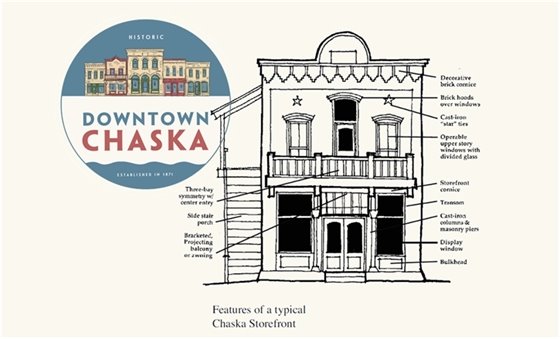
In most typical Minnesota towns, “main street” buildings were two or three stories tall with a visual difference between the ground and upper stories to reflect the separate functions of each floor. Ground floors were primarily retail businesses. Storefronts consisted of large glass windows used for merchandise display. Wooden or metal bulkheads were installed at the bottom of these windows. A transom of clerestory glass capped with a horizontal molding was often placed above the display window. Buildings in Chaska follow this character, but Chaska’s buildings are limited in almost all instances to two stories in scale. Historically, transom windows allowed for added interior light as well as ventilation on hot summer days. The store sign was typically mounted above the transom molding. Signage was confined to the area above the display window because it was meant to be read by pedestrian traffic; not from cars speeding by at 40 mph. The upper stories served as the shopkeeper’s apartment or were rented as apartments. The means of egress from these dwelling spaces is expressed with exterior porches and exit stairs, and through street front balconies that are evident in historical photos. |
|
|
|
Strong emphasis was placed on the symmetry of street fronts, and continuity of scale and detail from one building to the next. This was meant to keep the downtown atmosphere on a pedestrian level. Often upper floors were visually separated from the first floor by a “belt course” of brick projecting outward, or more typically by projecting, bracketed balconies. Smaller, evenly spaced windows on upper stories also helped underscore the different purpose of the floors. Other facade features in a typical Minnesota downtown might include window hoods, ornamental cornices, brackets and columns. In Chaska, these decorative features were constructed, more often than not, by the way the bricks were placed, forming corbels and projections over windows and at the top of a storefront or “cornice”. Ornamental cast-iron columns (probably manufactured at the Ess Foundry) are used as a decorative feature at several building entrances (like the Chaska Herald building at 123 W. Second St., Figure 1) and cast iron “stars” or other metal shapes are used as tie-rod ends to hold the brick together on other buildings (like the Chaska Mill building; 500 N. Pine St., Figure 2). |
|
|
|
 Figure 1. Chaska Herald Building Figure 2. Chaska Mill Building Figure 3. Simons Building
|
|
|
|
Limestone was used selectively on a few buildings, both for practicality (as on window sills) and for ornament (as with the name blocks atop the cornice on buildings like the Simons block, Figure 3). These elements all emphasize the shape and lines of the facade. Window hoods emphasize patterns and spacing of windows. The limestone is less elaborately carved than on later buildings in other Minnesota towns, and appears to have been quarried from limestone beds in places like Kasota or Ottawa or Mankato, nearby in the Minnesota River Valley. Again, this is a both reflection of practicality and something that gives Chaska a character distinct from most other communities in the region. Ornamental cornices of either brick or stone define the framing and outline of the building. The results provided a unified cityscape.
The authors of this study observed at least one other pattern that sets Chaska apart from most other Minnesota communities. That is in the way spaces between and behind buildings have been used. The standard assumption about Minnesota downtown commercial districts is that they are always built “lot-line to lot-line”, and that spaces between buildings were never planned for in the way downtown commercial property was laid out. In surveying Chaska, notice the number of buildings that include an exterior egress stair from the upper story, often with an exterior porch constructed of wood at the building’s side or rear (as at the Linenfelser-Faber Building at 116-120 East Second St., Figure 4.)
|
|
|
|
 Figure 4 and 5. Exterior staircase and 2nd floor porch Figure 6. Simons Livery
|
|
|
|
A higher than average number of freestanding residential properties survive in downtown Chaska, often closely integrated into the fabric of commercial buildings (like the Young House located at 109 E. Second St., Figure 5). Alleyways and spaces between many buildings have clearly been undeveloped since the early days, and in many cases seem to have been preserved intentionally to allow ventilation and daylight into windows on building sidewalls (as with the Simon Livery stable building at 123 W. Third St., Figure 6).
It is clear that, through the years, property owners of many of Chaska’s buildings have maintained their exteriors in excellent, original condition, clearly appreciating what is distinctive and handsome about them. At a time when many Minnesota downtown commercial buildings were being demolished in the 1950s, 60s, and 70s; many Chaska property owners were restoring the buildings’ exteriors to their accurate historic appearance. The effort placed in buildings like the Simons Block and the Chaska Mill is remarkable and is an aspect of community that should continue being capitalized on as a way of celebrating Chaska’s uniqueness.
|
|
|
|
|
|
|
|
|
|




 Share on Facebook
 Share on Twitter
 Share via Email
